
7 CBT Techniques to Beat a Nicotine Craving in Five Minutes
Cravings peak and fade within minutes. These seven Cognitive Behavioural Therapy techniques give you something concrete to do while that happens.
A craving is not a command. It is a short, self-limiting wave of discomfort that peaks in about two to three minutes and fades on its own — whether or not you smoke.
The problem is that two minutes with nothing to do feels like twenty. CBT works by giving those minutes a job.
1. Urge surfing
Instead of fighting the craving, describe it. Where is it in your body — chest, throat, hands? Is it hot or tight? Rising or falling? Narrating a sensation moves activity away from the reactive part of the brain and the urge loses its grip.
You are not trying to make it go away. You are watching it go away by itself.
2. The 4–7–8 breath
Inhale through the nose for 4, hold for 7, exhale slowly through the mouth for 8. Three rounds.
This lengthened exhale slows the heart rate and directly counters the stress arousal that makes a craving feel urgent. It is the first tool we unlock for every Mentovia member, free tier included, because it works anywhere and needs nothing.
3. Delay with a timer
Do not say no. Say "not for four minutes" and start a timer on your phone.
Delay is psychologically easier than refusal, and almost every craving fails to survive the timer. When it ends, run the timer again if you need to.
4. Trigger mapping
Cravings are cued, not random. Write down the four situations that produce most of yours — the first coffee, the drive home, alcohol, an argument.
For each one, pre-decide a replacement action. Not "resist" — a specific, physical alternative. Coffee outside instead of on the balcony. Phone charging in the kitchen after 9pm. The decision must be made in advance; you will not make it well mid-craving.
5. Thought challenging
Catch the sentence in your head and test it:
> "I can't cope with this stress without a cigarette."
Ask three questions: Is it literally true? What is the evidence against it? What would I tell a friend who said this?
Smoking does not reduce stress — it briefly relieves nicotine withdrawal, which is itself a source of stress. Ex-smokers report lower anxiety levels after quitting, not higher.
6. The play-the-tape-forward technique
Do not stop the fantasy at the first satisfying drag. Play the whole tape: the taste, the smell on your fingers, the deflation ten minutes later, the reset counter, the conversation you have with yourself tomorrow.
Cravings sell you a five-second highlight reel. Watch the full film.
7. Reward substitution
Nicotine hijacked a reward circuit that still needs feeding. Give it something else that produces a genuine hit: a walk outside, cold water on the face, ten press-ups, a message to someone who is rooting for you.
Small, immediate and physical beats large and distant.
Making the techniques stick
Reading them is not learning them. Rehearse two of these when you are not craving, so the pathway exists when you are.
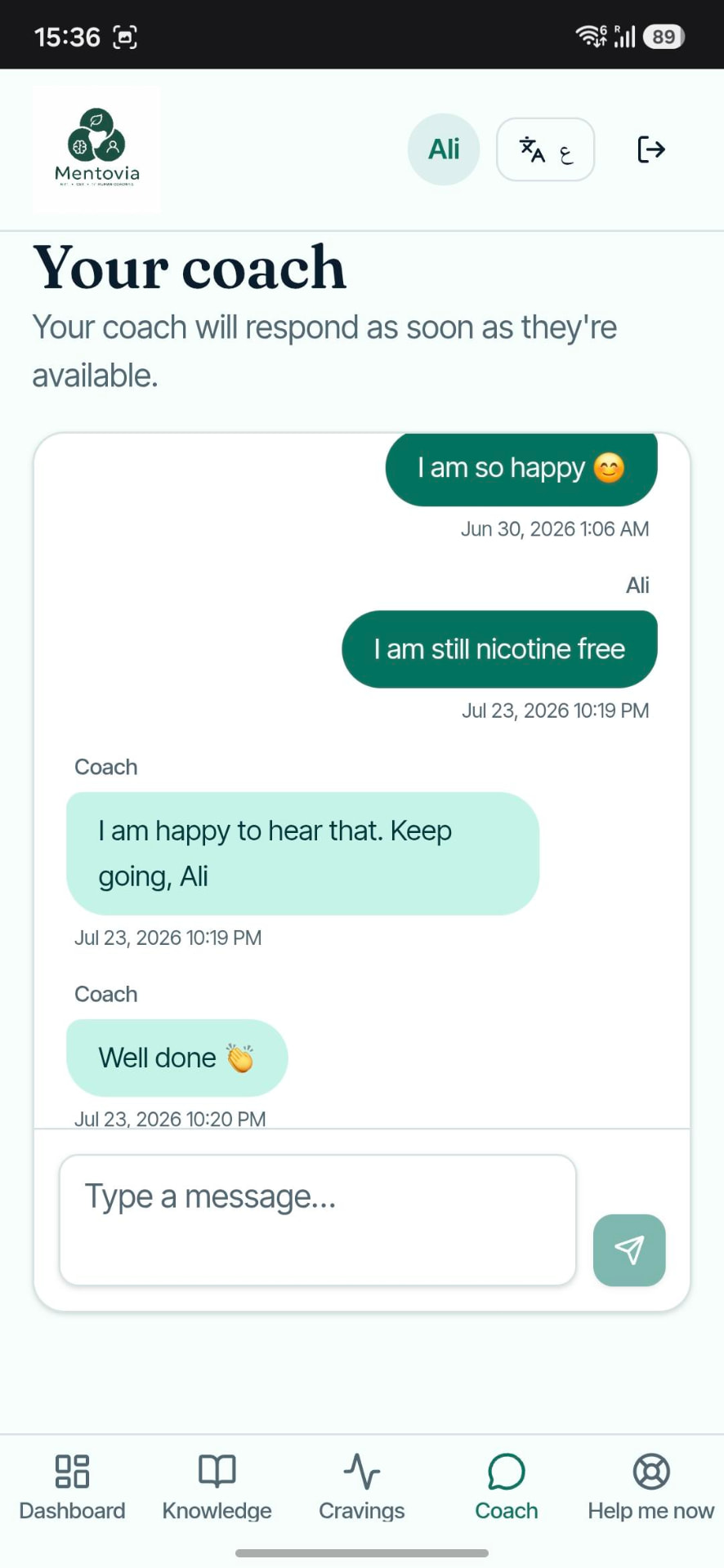
Mentovia's Knowledge module turns these into short, gamified CBT lessons paced across your quit — one idea at a time, with a coach available in-app when a technique needs adapting to your life rather than a textbook.
Frequently asked questions
- How long does a nicotine craving last?
- A single craving typically peaks within two to three minutes and fades within five. It feels longer because attention magnifies it.
- Does CBT help with quitting smoking?
- Yes. Behavioural support combined with nicotine replacement therapy is substantially more effective than medication or willpower alone.
Ready to put this into practice?
Mentovia gives you an NRT plan, CBT lessons and a coach in your pocket — start free, upgrade whenever you're ready.