
How to Quit Vaping: A 4-Week Plan That Actually Works
A practical, evidence-based 4-week plan to quit vaping — how to taper nicotine strength, handle cravings, and stay stopped without white-knuckling it.
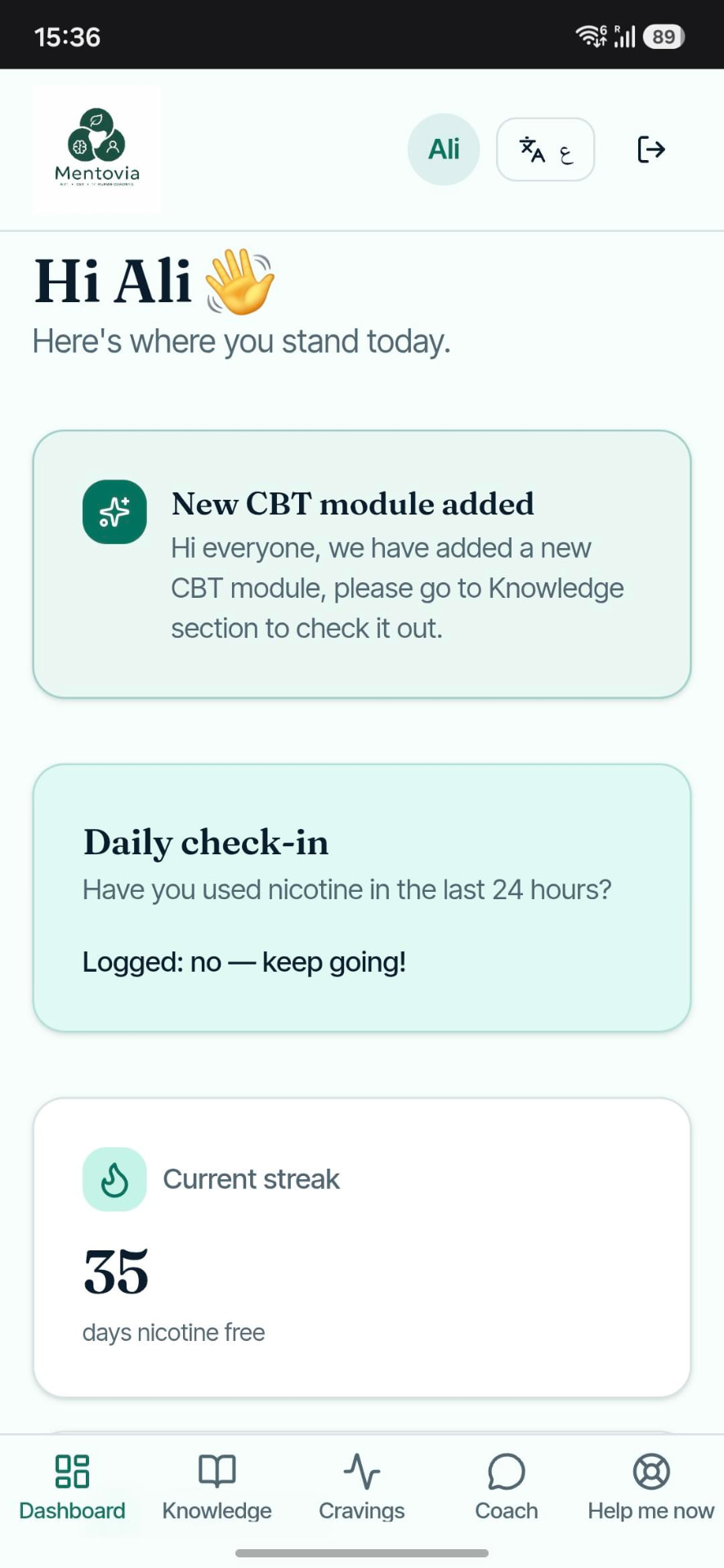
Vaping is easier to start than it is to stop. There is no ash, no smell and no obvious "last one" — so most people vape more nicotine per day than they ever smoked, and they do it without noticing.
That is the good news, in a way. The habit is chemical and situational, not moral. Break the chemistry and rewire the situations and the habit collapses.
Here is the four-week plan we use with Mentovia members.
Week 1 — Measure before you change anything
Do not quit yet. Spend seven days getting honest data:
- What nicotine strength is your liquid or pod (mg/ml)?
- Roughly how many pods or tanks per week?
- When do you reach for it? Log the first hour of the day, breaks, driving, after meals, and stress.
Most people discover that 70% of their vaping happens in four or five repeatable moments. Those moments — not willpower — are what you will actually be treating.
Week 2 — Cut the strength, not the puffs
Drop one nicotine step (for example 20 mg/ml to 10 mg/ml, or 50 mg salt to 25 mg). Keep vaping as often as you like.
This matters because your brain regulates nicotine, not vapour. If you try to reduce puffs first, you compensate by inhaling harder. Reduce the concentration and your intake genuinely falls.
> Clinical rule of thumb: cut strength first, frequency second. It is the reverse of what most people try — and the reverse of what works.
Week 3 — Add NRT and pick your quit date
Start a nicotine patch two or three days before your quit date so a steady baseline is already in your system. Add a fast-acting product — gum, lozenge, mouth spray or inhalator — for cravings.
Combination NRT (patch plus one fast-acting product) is consistently more effective than a single product. This is standard NCSCT guidance in UK stop-smoking services, and it applies to vapers too.
Choose a quit date at the end of the week. Put it in your calendar. Tell one person.
Week 4 — Quit day and the 72-hour window
The first three days are the hardest and the shortest. Plan for them:
- Remove the device. Not in a drawer — out of the house. Proximity beats intention.
- Change the geography of your triggers. New route to work, coffee in a different chair, phone in another room after dinner.
- Use the four-minute rule. Cravings peak and fade in three to five minutes. Set a timer and do something with your hands until it passes.
- Breathe deliberately. 4–7–8 breathing (inhale 4, hold 7, exhale 8) interrupts the stress response that makes a craving feel urgent.
- Eat and drink on schedule. Low blood sugar and dehydration are frequently mistaken for nicotine cravings.
What to expect afterwards
- Days 1–3: irritability, poor concentration, disrupted sleep, strong urges.
- Week 1–2: urges become shorter but arrive suddenly, often around alcohol or stress.
- Week 3–4: most physical withdrawal has resolved; the remaining battle is situational.
- Month 2 onwards: cravings become occasional and brief. The main risk is the "just one" test.
The one mistake that undoes most quit attempts
Trying one puff to prove you are in control. Nicotine dependence is re-established remarkably fast — often within a day or two of a single relapse episode.
If you slip, treat it as data, not failure. Which trigger caught you? What will you do differently next time? People who analyse a slip within 24 hours are far more likely to stay stopped than people who wait a week and drift back.
Getting support that fits around you
Structured support roughly triples the odds of a quit attempt succeeding compared with going it alone. Mentovia combines the three pieces that matter — NRT guidance, CBT lessons that retrain triggers, and a coach available 24/7 — inside one private app.
Start with the free tools: work out what your habit costs you, learn the 4–7–8 technique, and set your quit date.
Frequently asked questions
- How long does nicotine withdrawal from vaping last?
- The sharpest physical symptoms usually peak in the first 72 hours and settle within two to four weeks. Occasional psychological cravings can surface for a few months, but they get shorter and weaker each week.
- Is it better to taper nicotine strength or stop vaping all at once?
- Both work. Tapering suits high-strength users (20 mg/ml and above) because it softens withdrawal, while stopping abruptly with NRT support suits people who find half-measures harder to stick to.
- Can you use nicotine patches to quit vaping?
- Yes. Nicotine replacement therapy is licensed for anyone dependent on nicotine, not just cigarette smokers, and a patch plus a fast-acting product such as gum or a lozenge is the most effective combination.
Ready to put this into practice?
Mentovia gives you an NRT plan, CBT lessons and a coach in your pocket — start free, upgrade whenever you're ready.